
Your Best HVAC Leads Are in Your ServiceTitan Database🔗
Eight years ago, your crew installed a system for a homeowner in your market. The install went smoothly, and they left a good review. Then the relationship went cold. Nobody called to check in, offered a service agreement, or scheduled a maintenance visit. Today, that system is probably approaching the end of its useful life, and the homeowner just booked a replacement with a competitor who showed up first in a search.
You already paid to acquire that customer once. Research cited by Harvard Business Review found that acquiring a new customer costs 5 to 25 times more than retaining an existing one. Letting that relationship go cold and then competing to win it back from scratch is the most expensive lead a contractor can generate, and it is entirely avoidable.
The underutilization problem no one talks about🔗
Field service management platforms like ServiceTitan are built to do far more than scheduling and invoicing. Dispatch, customer history, CRM functions, and marketing automation all sit inside the same system most contractors already pay for. In practice, most use a fraction of it.
Paul Adams, founder of Columbia Home Services, which operates 23 brands across seven states, put this plainly in a conversation on the AI in Trades Podcast:
"ServiceTitan is a very powerful system. But the utilization of something like ServiceTitan is often lower than one might expect... We become more complacent. We've got two or three applications that we use, and then we just choose not to do anything more."
That pattern shows up in the data too. ServiceTitan's 2025 Residential Industry Report, which polled more than 1,000 residential contractors, found 63% describe their business as thriving or experiencing consistent growth, while 19% are surviving and 18% are struggling. The report notes that thriving contractors distinguish themselves in part by investing in additional technology rather than settling into the two or three tools Adams describes. The bottleneck is not what the platform can do, but how consistently contractors use it.
What's sitting inside your customer database right now🔗
The customer database most contractors have accumulated over years of completed jobs already contains the outline of a lead generation engine, even if it has never been treated as one.
Every system your company installed has an install date and a typical service life. Every customer has a service agreement status, active, lapsed, or never enrolled. Every household that bought HVAC service from you has a plumbing and electrical need that another contractor is currently handling instead. None of this requires new data, only surfacing data that already exists.
Adams framed the opportunity in exactly these terms:
"If you as the contractor installed a system eight to ten years ago, and you were to map all your customers against the average life of a typical system, you may find that those systems are due for replacement. It begs the question whether some AI algorithm can go into your field service management system and publish those opportunities to you."
That question is the whole premise of this post, and the opportunity it points to is not hypothetical but dormant.
Owned demand: The more durable lead source🔗
This connects directly to the cost per lead problem covered in the first post in this series. As paid channels get more expensive and AI search closes off the organic escape valve, the relative advantage of a lead you already own compounds. A reactivation call to someone who already trusts your brand does not compete in the same auction as a cold click from an aggregator.
Mordor Intelligence's 2025 US HVAC Services Market Report found recurring service agreements already account for 55% of industry revenue, growing at an 8.3% CAGR, with preventive maintenance contracts alone capturing 39% of revenue. The shift toward owned, recurring relationships is already underway across the industry rather than a strategy contractors need to invent, and the contractors ahead of it are the ones treating their existing customer base as infrastructure rather than history.
Adams was direct about the economics driving that shift:
"It costs a lot of money to advertise. Why not take advantage of the people that you've already provided service to? They bought into your legacy or your brand, and it's sitting right there and you're not doing anything with it."
What AI-assisted data mining looks like day-to-day🔗
The gap between having this data and acting on it consistently is almost always a matter of operational capacity. A contractor's office staff already knows, in theory, that mining the reactivation and replacement data matters. What they lack is the time to manually query a database for it every week on top of everything else on their desk.
Adams described the constraint from inside a company running dozens of markets:
"The things that AI can do that our in-house staff is only capable of doing a fraction of, like mining your existing customer base to see how many customers have a replacement system that's probably due... The person in the office is wearing five different hats and they can't get to all those customers."
Done well, this looks like a prioritized list that shows up automatically rather than a report someone has to remember to run as it surfaces replacement-age systems each morning, triggers outbound sequences for customers with no active service agreement, and flags other open opportunities in the household to technicians already on-site before they leave the driveway. The person wearing five hats in the office does not get replaced by this so much as handed a prioritized list instead of a blank search.
The mindset shift this actually requires🔗
None of this is primarily a software purchase. Moving from treating a customer database as a system of record to treating it as a growth engine is an operational commitment, and it requires sales and operations teams to work from the same data instead of each optimizing their own separate metrics.
The contractors who make that shift are building a revenue stream that a change in Google's algorithm, an AI Overview, or a rising CPL cannot touch, because it depends on having already been chosen once rather than on being found again and again.
The lead generation model that built most home service businesses is under pressure it will not fully recover from, but the businesses that invested in earning customer trust over the years already have something more valuable than any ad budget: a database of people who already said yes, and the only question left is whether you put it to use.
How TitanSigma helps contractors turn their database into a growth engine🔗
Surfacing replacement, reactivation, and cross-sell opportunities consistently requires querying job history, install dates, and service agreement status together, something most contractors currently do through manual exports or not at all.
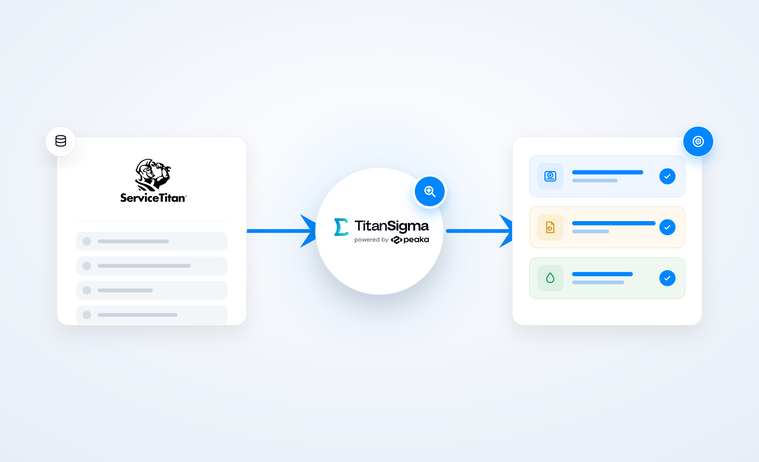
TitanSigma connects directly to ServiceTitan as a native partner and exposes every endpoint as a queryable data layer. As a result, you can map installed systems against expected replacement age, identify customers with lapsed or missing service agreements, and identifies households that bought one trade's service but never a second, all without building a data warehouse or waiting on a reporting team.
It also connects ServiceTitan to the other systems that make this actionable. Marketing automation platforms need clean, current lists to run reactivation campaigns. CRMs need to reflect service agreement status so a technician on-site knows what else to mention before they leave the driveway. TitanSigma joins these sources at the query level, so a prioritized opportunity list can flow into the tools your team already uses instead of sitting in a report nobody opens.
For contractors ready to treat their customer database as a growth engine instead of a historical record, the missing piece is usually the operational infrastructure to surface those opportunities every day, not the data itself.
Book a demo to see TitanSigma in action.
This is the third and final post in a three-part series on the future of home service growth, informed by conversations on the AI in Trades Podcast. The first post, why HVAC lead generation costs keep rising, covered the paid lead cost squeeze and how AI search is closing off the organic alternative. The second post, why your HVAC sales process is losing half your buyers, examined how contractors need to serve relationship and digital buyers within the same sales process. This post closes the loop: the most durable answer to rising lead costs and split buyer behavior is the customer base a contractor has already earned.