
Why Your HVAC Sales Process Is Losing Half Your Buyers🔗
If your close rate has gotten harder to predict even as lead quality holds steady, the issue may not be your technicians or your pricing. It may be that your sales process assumes every homeowner buys the same way, and that assumption stopped being true.
Contractors who structure their proposals well already see the effect of getting this right. A survey of more than 1,000 HVAC contractors by the Air Conditioning Contractors of America and Farmington Consulting Group found that contractors offering four or more options in a proposal close at 52%, a full 10 percentage points higher than the 42% close rate among contractors who offer fewer choices. That gap comes down to how well the sales process matches the way the buyer in front of you wants to decide.
That distinction is becoming the central challenge in home services sales, and it splits along a line that has little to do with the job itself.
Two kinds of buyers, one sales process built for neither🔗
Paul Adams, founder of Columbia Home Services, which operates 23 brands across seven states, described this split directly in a conversation on the AI in Trades Podcast:
"There are people in the market with different homeowner behaviors. We really want relationships, we want reassurance, we're open to phone conversations with the contractor, we want to trust the technician when they come into the home. The other customers we have out there, they want speed, they want transparency, they want self-service. Contractors were not and are not prepared for both of those buying behaviors."
The data backs up what Adams is describing from inside a company running dozens of markets. Weave's home services survey found millennials are 64% more likely to choose a provider that offers digital tools, compared to 28% for baby boomers, a gap wide enough that the two groups are effectively responding to different sales pitches. Gen Z buyers go further still, with three in five saying they would not hire a home service provider with no online reviews at all.
Meanwhile, ServiceTitan's 2025 Consumer Trends Report, produced with Synchrony and Visa, found 80% of homeowners now begin their search online regardless of age, which means even relationship-oriented buyers arrive at your business through a digital front door before a single phone call happens. What matters after that first contact is what each buyer expects from the sales process itself.
Why jamming both buyer types into one process creates friction🔗
For Adams, this is nothing but forcing every buyer through "one sales process and one communication style and one booking flow and one estimate format." A relationship buyer pushed through a rushed, transactional pitch feels unheard and walks away distrustful. A digital buyer forced into a long in-home consultation with no online scheduling option and no price transparency simply looks elsewhere before your technician arrives.
The cost of that mismatch shows up in the numbers on both ends. On the relationship side, an under-explained financing option or a rushed proposal loses the trust that a kitchen-table sale depends on. On the digital side, ServiceTitan's data shows leading with total system cost instead of a monthly payment figure cuts the financed-sale rate nearly in half, from 42% down to 21%, because digital buyers evaluate affordability before they evaluate trust.
Both failure modes are avoidable, but not by choosing one process and optimizing it harder. They require running two processes at once.
What a dual-path sales process actually looks like🔗
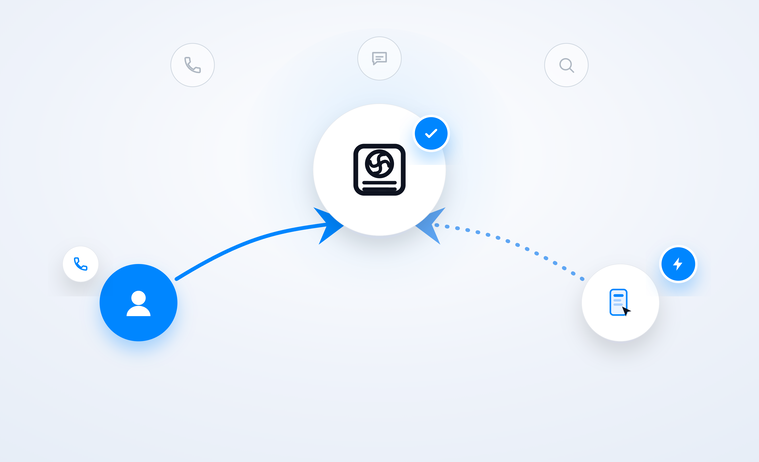
Adams describes what he calls the dual-path customer acquisition model, and lays out both tracks in concrete terms.
Path A serves the relationship buyer, who expects a live phone conversation with a real person, an in-home visit that walks through good, better, and best options with a financing explanation delivered face to face, and a follow-up call afterward, what Adams calls the old-school "happy call," to confirm satisfaction and introduce a membership program.
Path B serves the digital buyer, who is comfortable with online booking, text-based communication, a financing prequalification before a technician ever shows up, a digital proposal that leads with the monthly payment rather than the sticker price, an e-signature to close, and follow-up that never requires a second home visit.
"What's happening is it's what I will also coin as 'human when desired, digital when preferred.' And that distinction matters enormously if contractors want to win."
The two paths end at the same place, a closed job and a customer enrolled in a service agreement, but a contractor running only one of them is structurally unable to close the buyers who need the other.
Leveraging brand identity to reconcile the two paths🔗
Running two sales tracks only works if both reinforce the same reputation, because both buyer types are evaluating the same signal from different directions. Adams pointed to online reviews specifically, noting that what used to be a nice-to-have is now infrastructure. A relationship buyer hears about your reputation from a neighbor or checks it before making the call. A digital buyer will not book at all without seeing it first, in line with the three-in-five Gen Z figure above.
That means the technician conversation happening in a homeowner's kitchen and the review a digital buyer reads at 11 p.m. while comparing three providers are both, in effect, the same sales pitch. Adams frames this as brand identity becoming more central than either channel alone. A strong answer to the question "what is the reason that you want to do business with this particular contractor?" has to hold up whether it is delivered by a technician in person or read as a star rating on a phone screen.
How CRM and technician enablement improve conversion rate🔗
Running two parallel sales processes is an operational commitment that goes well beyond writing two sales scripts, and Adams is candid that it shifts more ownership onto operations teams than it used to. His team has invested in call center sophistication, CRM automation, and financing integration specifically to support technicians who are closing the majority of jobs in the field.
"Eighty percent of what gets sold out there gets sold through a technician. This is where AI can make their lives maybe a little bit easier... Sophisticated groups are investing heavily into their field service management."
The mechanism matters as much as the intent. A technician standing in front of a relationship buyer who asks an unexpected question about, say, indoor air quality cost, a financing term, or a comparable system spec, can now query an AI tool from the truck and answer it in plain language on the spot. This helps close the kind of information gap that used to end in "let me get back to you." A digital buyer's online booking and financing prequalification only work if that data flows cleanly into the CRM and field service platform the technician sees before they knock on the door. Neither path closes reliably if the systems behind it are disconnected.
How TitanSigma helps contractors run both paths🔗
Running a dual-path sales process means your CRM, your field service management platform, and your financing provider all need to work from the same customer record, or your team ends up reconciling two versions of the truth about every deal in progress.
TitanSigma connects directly to ServiceTitan as a native partner and exposes every endpoint as a queryable data layer, so you can see close rates, financed sales share, and proposal option counts broken out by lead source, technician, or sales channel without waiting on a manual data export. That makes it possible to actually measure whether your relationship-path and digital-path customers are converting at the rates you expect, rather than assuming one sales process is working for both.
It also connects ServiceTitan to the other systems both paths depend on. Financing approvals, CRM activity, and technician performance data often live in separate platforms that do not talk to each other by default. TitanSigma joins them at the query level, so a sales manager can see whether online bookings and digital proposals are closing at the same rate as in-home sales visits, and how often customers choose financing across different technicians, channels, or customer segments, all from a single view instead of three disconnected reports.
For contractors building the operational muscle to run two sales processes well, the visibility to know which one needs attention is usually the missing piece.
Book a demo to see TitanSigma in action.
This is the second post in a three-part series on the future of home service growth, informed by conversations on the AI in Trades Podcast. The first post in this series, why HVAC lead generation costs keep rising, covered the paid lead cost squeeze and how AI search is closing off the organic alternative. The third post looks at what happens once a job is sold and a technician is on site, and how AI is starting to reshape field operations themselves.