
How PEs Can Unify Data from Multiple ServiceTitan Instances🔗
When a private equity firm rolls up multiple home service businesses operating in plumbing, HVAC, electrical, or pest control, there’s a high chance each acquired brand runs its own ServiceTitan account. While this best-in-class software helps operators manage scheduling, dispatch, and invoicing, it wasn’t built with multi-entity portfolio reporting in mind.
What begins as a tech upgrade at the individual company level quickly becomes a reporting and data integration nightmare at the platform level. KPIs don’t line up. Data sits in silos. Board decks rely on delayed, manual exports. For firms operating on a 3-5 year value creation timeline, this fragmentation acts as a bottleneck to EBITDA growth.
This guide is for private equity operating teams and finance leaders who need a practical way to unify ServiceTitan data across multiple brands or instances, normalize KPI definitions, and create a consistent reporting layer that survives the next acquisition.
If you are a ServiceTitan consultant managing separate client accounts, read our blog post for multi-account ServiceTitan consultants.
If you are a contractor running multiple branches within one company, start by understanding the challenges of multi-location ServiceTitan reporting first.
For a complete end-to-end roadmap for a multi-location home service business, check out our comprehensive guide on multi-location ServiceTitan reporting.
The problem with disconnected ServiceTitan instances🔗
Most home service roll-ups result in each brand retaining its own ServiceTitan environment. While this allows for a smoother transition as teams continue working with a platform they are already familiar with, it also leads to a few problems:
-
Inconsistent reporting: Each entity maintains its reporting habits, with KPIs being defined and calculated slightly differently across the portfolio.
-
Manual processes: Data replication from one spreadsheet to another and manual data exports via CSV remain the primary methods of data consolidation.
-
No real-time insights: Without a unified, live view of data, leadership and portfolio managers lack the data needed to draw insights from and have to rely on outdated data.
-
Blind spots across brands: It’s nearly impossible to benchmark technician utilization, close rates, or marketing ROI across the portfolio in the absence of integrated data and standardized metrics.
As Peter Drucker once said, “You can’t manage what you can’t measure.” This is especially true for PE firms that lack a single source of truth across their portfolio. It means flying blind when it comes to performance optimization and wasting precious weeks every quarter preparing investor updates.
What ServiceTitan PE operating teams actually need🔗
A central view of portfolio performance isn’t a simple reporting upgrade; it’s a source of competitive edge when you’re rolling up underperforming home service companies. Here’s why:
-
Benchmarking across brands becomes possible. Why are jobs closing faster in Dallas but not in Phoenix? Is one brand’s tech utilization lagging?
-
Revenue leaks, margin opportunities, and unusual trends are easier to spot when KPIs are normalized across entities.
-
Faster time-to-insight helps PE firms stay agile, especially when strategic decisions must be made between board meetings.
-
Board and LP reporting becomes more consistent, more reliable, and less dependent on ad hoc Excel work.
In short, centralized data unlocks the full potential of a buy-and-build strategy.
The traditional data stack: Why it doesn’t work for PE roll-ups🔗
Some firms attempt to unify their ServiceTitan data by assembling a traditional data stack. On paper, it seems the logical thing to do: use Fivetran or Airbyte to extract data, store it in Snowflake or BigQuery, model it in dbt, and visualize it in Tableau or Power BI. But the reality? It’s a bad fit for the needs of a PE firm for a variety of reasons:
-
Cost: Traditional data stacks require significant upfront investment in tools, data engineers, and months of setup, which easily add up to $150K+ per year.
-
Complexity: Most operators lack in-house data teams to run and maintain these systems, resulting in these initiatives becoming full-blown IT projects with six-figure costs and unclear ROI.
-
Misalignment with PE timeline: By the time a traditional data stack begins delivering ROI, a PE is halfway through its value creation window, which typically lasts 3-5 years.
All in all, the capabilities of traditional data stacks are overkill for companies that are simply trying to surface technician performance or revenue per job and fire up real-time KPI dashboards.
PE firms don’t need a data warehouse; what they need is answers. Fast. That’s why a nimble solution like TitanSigma, which connects directly to multiple ServiceTitan instances and delivers insights within days, is far better suited for lean operating teams and compressed timelines.
What the ideal solution looks like🔗
A solution designed for PE operators needs to go beyond point-to-point integration. It should:
-
Connect to multiple ServiceTitan accounts at once
-
Normalize data schemas across brands and define standardized KPIs
-
Integrate ServiceTitan with accounting tools like QuickBooks, XeroAccounting, or Sage Intacct
-
Require minimal IT involvement, given most operators lack full-stack data teams
-
Work with modern BI tools, supporting dashboards in Power BI, Looker Studio, and more
How TitanSigma solves the fragmentation problem🔗
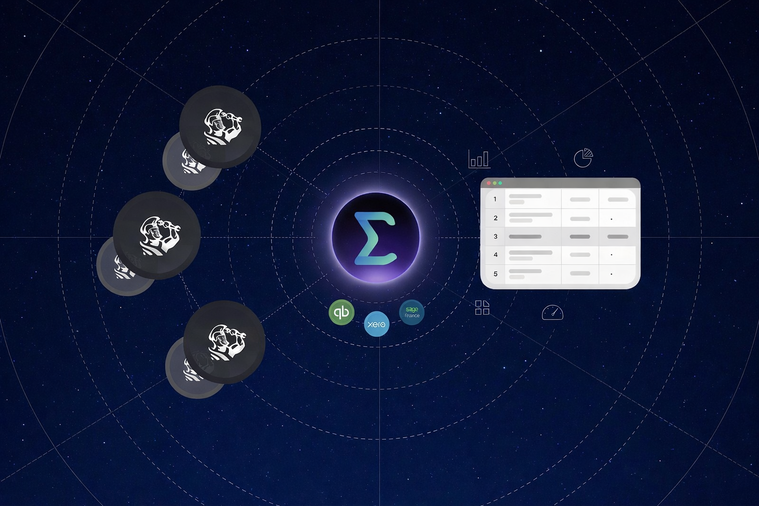
TitanSigma was built with multi-tenant ServiceTitan environments in mind. This makes it ideal for PE-backed home service platforms.
Here’s how it works:
-
Connects directly to each ServiceTitan instance: No custom engineering or connector development required.
-
Creates a unified data layer: TitanSigma consolidates and models data from each brand into a single, standardized structure.
-
Visualizes performance KPIs in real time: Revenue trends, job close rates, technician efficiency, and more are available instantly.
-
Reduces reliance on data teams: With text-to-SQL capability, even non-technical users can explore, filter, and report on portfolio data.
-
Deploys in days, not months: Perfect for value creation plans where every quarter counts.
Key takeaways🔗
-
PE-led roll-ups using ServiceTitan often struggle with fragmented data and inconsistent reporting.
-
Unifying these ServiceTitan instances enables faster insights, better benchmarking, and higher ROI.
-
TitanSigma offers a fast, low-lift way to centralize multi-brand performance data—no data warehouse or BI team required.
Getting started with TitanSigma🔗
If you’re managing a growing portfolio of ServiceTitan-based businesses, you don’t need to keep stitching together spreadsheets or waiting on analysts. TitanSigma can help you unify your data, accelerate reporting, and create the visibility your value creation plan demands.
Start with these simple, step-by-step walkthroughs and build some of the most frequently used reports in a few minutes:
-
How to List Invoice Data Across Multiple ServiceTitan Accounts
-
Listing All Jobs for an Employee in ServiceTitan Using TitanSigma
Book a demo to see how we help PE firms simplify ServiceTitan data integration and unlock portfolio-wide insights in days, not months.